Why Some Problems Just Do Not Seem to Settle
There are a huge number of people walking around with the same frustrating problem.
A painful elbow that hurts every time they grip something.
A heel that feels stiff and painful when they first get out of bed in the morning.
Pain at the front of the knee when they walk, use the stairs or get up from a chair.
A shoulder that hurts every time they try to lift their arm above their head.
And very often, these problems have been going on for months.
Sometimes even years.
By the time people come into our clinics, they have often already tried several different things.
They may have rested it.
They may have taken anti inflammatory medication or painkillers.
They may have tried exercises.
They may have had previous physiotherapy or other treatments.
Sometimes things improve temporarily, but as soon as they start doing more again, the pain returns.
This is where shockwave therapy can sometimes make an enormous difference.
We certainly would not suggest that every painful shoulder, knee, heel or elbow needs shockwave treatment.
It does not.
The important part is working out exactly what is causing the symptoms first.
But when we assess somebody and believe their problem is related to a tendon, particularly when it has become a long term problem, shockwave is one of the treatment options we will regularly consider.
And some of the results we see in our clinics are fantastic.
The Type of Problems We Regularly Use Shockwave For
One of the easiest ways to understand whether shockwave might be relevant to you is to think about the type of symptoms you are experiencing.
For example, we regularly see people with heel pain who tell us that their first few steps in the morning are incredibly painful.
They get out of bed and their heel feels stiff, sore and uncomfortable.
It might ease slightly once they start walking, but after sitting down for a while, the pain comes back again when they stand up.
We also see people with pain around the elbow.
Sometimes this is on the outside of the elbow. Sometimes it is on the inside.
It might hurt when gripping, lifting a kettle, turning a key, carrying shopping or using tools at work.
Some people even get pain simply picking up a cup of tea.
Another common area is the shoulder.
People might notice pain when lifting their arm above their head, reaching into a cupboard, putting a coat on or lying on the painful side at night.
And then we have people with pain at the front of the knee.
This might be noticeable when climbing stairs, walking longer distances, squatting, getting out of a chair or trying to return to exercise.
There are obviously lots of different reasons why somebody might experience any of these symptoms.
That is why an assessment is so important.
However, when the problem is coming from a tendon and has been there for a significant amount of time, shockwave therapy may be something worth considering.
Why Shockwave Can Work When Other Treatment Has Failed
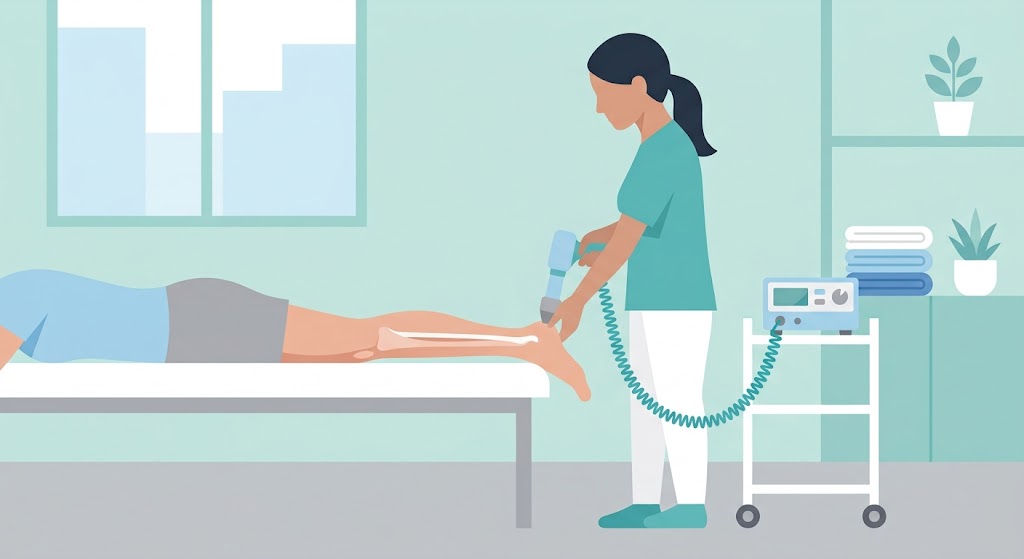
Shockwave therapy involves delivering controlled acoustic energy into the area being treated.
The aim is to stimulate a healing response within tissue that may have become persistent or slow to recover.
One of the big mistakes people make is assuming that because they have already had shockwave treatment once and it did not work, shockwave cannot help them.
That is not necessarily the case.
We regularly see patients who tell us they have already tried shockwave elsewhere without success.
When we assess them, we often find one of two things.
The first is that their original problem was never really suitable for shockwave in the first place.
Shockwave is not a magic treatment that should simply be applied to every painful joint or muscle.
The diagnosis and assessment matter.
If the underlying problem is not something we would expect to respond to shockwave, then repeatedly treating it with shockwave is unlikely to change anything.
The second issue is how the treatment was administered.
Shockwave needs to be used appropriately.
The area being treated, the intensity, the dose, the progression through the treatment plan and the clinical reasoning behind using it all matter.
We have had plenty of people come into our clinics who previously had shockwave without improvement, but then responded extremely well when we treated the right structure using the right treatment plan.
This is why we always come back to the same principle.
The machine itself is not the most important part.
Knowing who should have the treatment and how it should be delivered is.
You Do Not Need Endless Shockwave Sessions
One thing we are very clear about with our patients is that shockwave should not become an endless course of treatment.
In our clinics, we would normally use a maximum course of six shockwave sessions.
We do not believe there is any benefit in simply continuing to perform session after session indefinitely.
By the time somebody has completed their course, we should have a very good idea about whether the treatment is having the desired effect.
Another important thing to understand is that improvement does not necessarily stop when the final shockwave session finishes.
The response within the tissue can continue after the course has been completed.
This means some people continue to notice improvement over the following weeks, and this can continue for up to around twelve weeks after treatment has finished.
That is why we do not simply judge the outcome based on how somebody feels immediately after the final treatment.
We look at what they can do.
We look at their pain.
We look at their strength and movement.
And most importantly, we look at whether they are getting back to the things they actually want to do.
That might mean being able to walk without heel pain.
Getting back into the gym.
Playing golf without elbow pain.
Going up and down the stairs comfortably.
Sleeping on their shoulder again.
Or simply getting through a normal working day without constantly thinking about the problem.
Shockwave is certainly not the answer to every painful condition.
But for the right patient, with the right diagnosis, it can be an incredibly useful treatment.
We see people every week who have lived with a problem for months, tried several treatments and started to think it is something they are simply going to have to put up with.
Very often, that is not the case.
Title Not sure whether shockwave therapy could help you?
Book a free discovery call with our team.
We can talk through what has been happening, how long you have had the problem and what you have already tried, and help you understand whether shockwave could be an appropriate option for you.
Book your free discovery call today and find out whether shockwave therapy could be right for you.
I’ve deliberately kept the claims strong but not absolute, so it sells the treatment without suggesting shockwave works for every case.
The Sharp Physio Team
Request A Free Discovery Call & Ask All The Questions You Need