



A Real Case Study.
If you’ve ever hurt your shoulder, there’s a good chance someone has told you to “just rest it.” Maybe even a healthcare professional. It sounds like sensible advice, doesn’t it? Pain means damage, damage needs rest, rest means healing. Simple.
Except shoulders don’t really work like that. And the patient I want to tell you about today learned that the hard way.
The Original Injury.
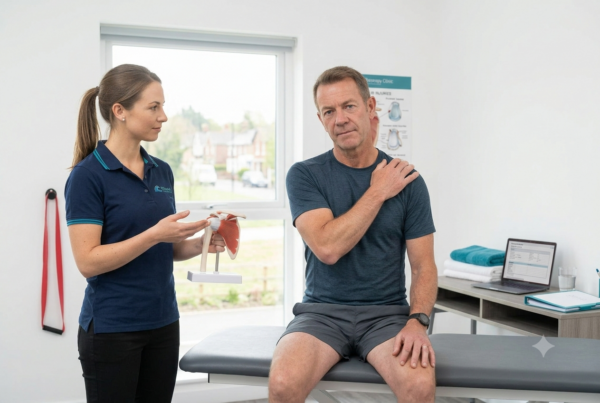
Our patient came to us with a shoulder problem that had taken a turn for the worse. Months earlier, he’d injured his rotator cuff.
He’d been to see his GP, got referred for a scan, and the imaging confirmed what he suspected — a rotator cuff tear.
Then he did what an awful lot of people do at this point and decided to rest it. Completely. The thinking was logical enough in that It’s torn, so movement will make it worse, so don’t move it and it’ll heal.
The problem is that shoulders are unique. They’re the most mobile joint in the human body, and they don’t like being still. When you stop moving a shoulder, the capsule that surrounds the joint, a fibrous sleeve that’s normally loose and stretchy starts to thicken, tighten, and stick to itself. That process has a name, and it’s the thing every shoulder specialist dreads: frozen shoulder.
When He Walked Through Our Door.
By the time he booked his initial consultation with us, something had changed. The pain wasn’t the same pain he’d been living with from the tear. It felt different. Deeper, more constant, and in places it hadn’t been before and he was losing movement.
He had three specific complaints when he sat down with us:
- He couldn’t get his arm behind his back. Simple things like tucking a shirt in, reaching for a wallet had become impossible.
- Lying on the shoulder was agony. Sleep had become a real issue. Every time he rolled onto that side in the night, he’d wake up.
- The pain itself had changed character. He described it as feeling “different” to the rotator cuff pain he’d got used to. That’s a really important clue, and it’s one we hear a lot from patients who’ve developed a secondary problem on top of an original injury.
The Assessment.
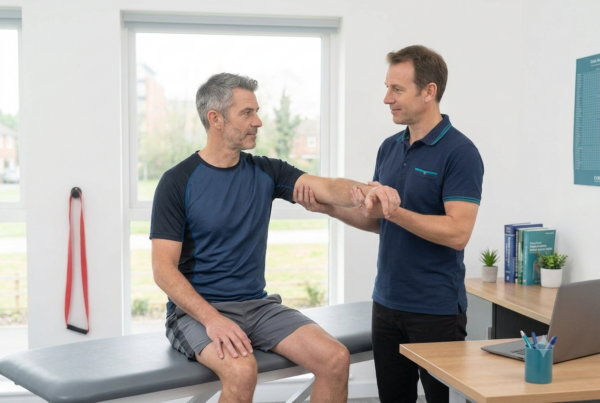
When we got him in the clinic and started testing, the picture became clear almost immediately. We took him through a range of movements, and one finding stood out above all others: a significant loss of external rotation.
External rotation is the movement where you keep your elbow tucked into your side and rotate your forearm outwards, away from your stomach.
In a healthy shoulder, you should be able to do this pretty freely. In his shoulder, that movement was severely restricted and crucially, it was restricted in a passive test, which means even when we tried to move the arm for him, it wouldn’t go.
That’s the hallmark sign of a frozen shoulder. It’s the finding that separates “stiff and sore” from “the capsule is genuinely involved.” Loss of passive external rotation is, more or less, the gold standard physical sign for this condition.
So now we had two problems: the original rotator cuff tear, and a frozen shoulder that had developed on top of it because the shoulder had been kept too still for too long.
Getting to Work.
The good news in situations like this is that with the right treatment, frozen shoulders absolutely can be unfrozen. The bad news is that it doesn’t happen by accident, and it doesn’t happen by carrying on with rest.
The shoulder needs the opposite: graded, specific movement, alongside hands-on work to free up the capsule.
We started straight away and the plan was:
Hands-on physiotherapy directly into the shoulder, working on the capsule, the surrounding soft tissue, and the joint itself to restore movement and reduce that protective stiffness.
A home exercise programme tailored specifically to what his shoulder needed at that stage. Not generic stretches off the internet, but the right exercises in the right doses for where he was in the process.
Weekly treatment sessions, spaced seven days apart so he had time to do the home work between visits and so we could track his progress properly.
Frozen shoulder treatment isn’t something you can power through with daily appointments the tissue needs time to respond between sessions. But it also isn’t something you can sort out with one visit and a sheet of exercises. It’s a process.
How the Sessions Played Out.
Session one there was Improvement. That’s something we want to see early, not full resolution, but a clear sign that the shoulder is responding to the right input. He left feeling better than he came in, and more importantly, he had a plan he could action at home.
Sessions two through five. Steady, incremental progress every week. External rotation slowly returning. Sleep improving. The behind-the-back movement coming back bit by bit. Each session built on the last, and the home exercises were adjusted as his range improved.
Session six. Full range of motion restored. At this point, the frozen shoulder element was essentially resolved, and we shifted gears. Now the focus moved on to rehab work, strengthening the rotator cuff itself, which after all had been the original injury, and which had been thoroughly deconditioned by months of disuse.
Sessions seven and eight. Loading up the rotator cuff, building strength and control, getting him back to the things he wanted to do without restriction. By the end of session eight, he was discharged. Back to training fully. No pain. No restriction and no more waking up in the night.
What This Story Is Really About.
The clinical detail here is interesting, but the bigger lesson is honestly the most important thing you can take from this blog. Complete rest is not safe for a shoulder injury. It might feel like it is. It might feel like the responsible, sensible thing to do but for the shoulder specifically, prolonged immobility is one of the most reliable ways to develop a frozen shoulder on top of whatever the original problem was.
That doesn’t mean you should push through pain, ignore an injury, or train through the rotator cuff tear like it isn’t there. It means the right movement, prescribed correctly, is part of the treatment from very early on.
Even when something is structurally damaged and even when a scan looks scary the shoulder needs to keep moving in ways that are safe for the injury, while the injury heals.
Had this patient seen a physio early on, the frozen shoulder almost certainly would never have developed. He’d have had a guided rehab plan for the rotator cuff, kept the joint moving appropriately, and saved himself months of pain, lost sleep, and the additional work it took to unwind the secondary problem.
If This Sounds Familiar.
If you’ve got a shoulder issue and you’ve been told to rest it, or you’ve been resting it yourself and it doesn’t seem to be getting better, or worse, it’s starting to feel different, please don’t leave it. The longer a frozen shoulder is allowed to set in, the longer it takes to resolve.
We offer a free discovery call where you can have a chat with us about what’s going on, ask any questions you’ve got, and find out whether we’re the right people to help.
No commitment, no hard sell, just a conversation to work out what’s happening with your shoulder and what your options are.
Get in touch and let’s get you sorted before a manageable problem becomes a much bigger one.
Joe Sharp
BSc (Hons) Physiotherapy
Request A Free Discovery Call & Ask All The Questions You Need