



Why your scan is clear but the pain is still there and what actually fixes it.
Does any of this sound like you? You can’t lie on your shoulder at night without waking up. You’ve had to stop training, maybe for months, maybe longer and you can feel yourself losing condition, strength, and the part of your routine that kept your head straight.
Work is harder than it should be. You’ve already seen a chiropractor, maybe a couple of physios, your GP. You might have tried peptides, injections, or supplements someone swore by. You’ve had a scan, and the report said something that boiled down to “nothing serious”. No tear, no surgery needed and yet the pain is still there every single day.
You’ve spent real money and now you’re skeptical. And honestly, you’re starting to wonder whether this is just how your shoulder is going to be from now on. If this sounds familiar I want to tell you about a patient I saw recently, because his story is almost exactly that and because the outcome was very different to what he expected when he walked through my door.
The Patient: A Stonemason Who Couldn't Lift Anymore
He came in as a bit of a last resort. He’s a stonemason by trade, used to train five days a week, and for the previous eighteen months he hadn’t been able to train at all. The shoulder and elbow pain had crept into every part of his life. He’d had to employ another member of staff to do the heavy laboring on site because he physically couldn’t manage it himself, which, as you can imagine, has a real financial and personal cost when your trade is built on what your body can do.
Before seeing me he’d been round the houses. Multiple chiropractors. Multiple physios. The GP. A course of peptides. None of it had touched the pain. He did bring one thing that turned out to be really useful: a recent MRI of his shoulder. The report showed no tear of the rotator cuff, but it did show a calcific rotator cuff tendon. That’s a calcium deposit sitting inside the tendon itself, and it’s a specific diagnosis with specific treatment implications which I’ll come back to.
The Assessment
Here’s something I think a lot of patients don’t appreciate: a scan tells you what is there but it doesn’t always tell you why it’s there, and it certainly doesn’t always tell you what to do about it.
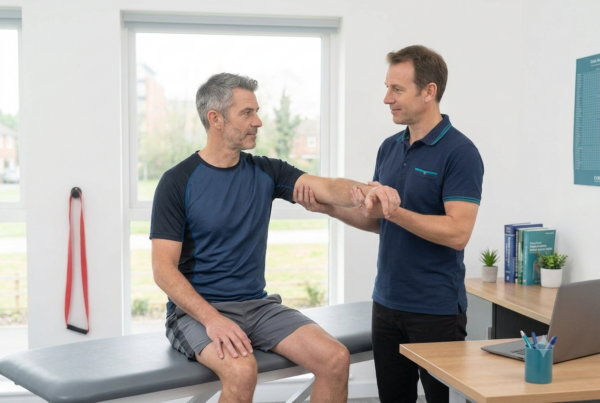
When I examined him, his clinical presentation lined up perfectly with the calcific tendon. He had pain on specific resisted tests, pain on direct palpation of the tendon itself. But the more interesting question for me was always going to be: why has this tendon become irritated and stayed irritated for a year and a half?
A few things stood out:
A significant muscle imbalance between the front of his shoulder and the back. The chest and front shoulder were doing all the work, and the posterior chain, the muscles that stabilize the shoulder blade and decelerate the arm was lagging well behind.
He also had a generally weak rotator cuff. When the small stabilizers can’t do their job, the larger tendons pick up loads they were never designed to manage, and that’s a recipe for a chronic tendon problem. He also tested positive for chronic tennis elbow on the same side.
So we weren’t dealing with one problem. We were dealing with two chronic tendon issues happening at the same time, driven by underlying mechanical and strength deficits that nothing he’d tried before had addressed.
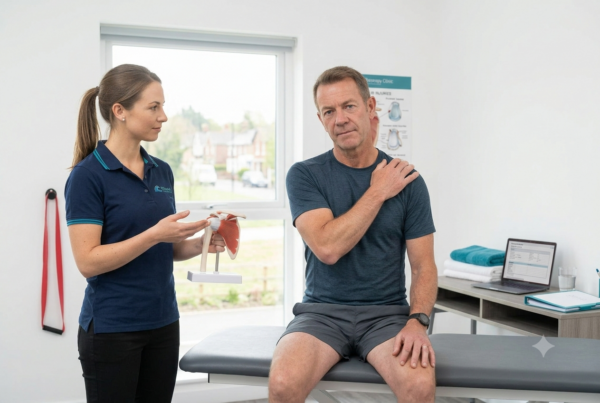
I explained all of this to him. The good news first: the scan didn’t show anything that needed an injection, an operation, or any further investigation. This was a physio problem but it was going to need the right combination of things, in the right order, to actually shift.
What Happened Next
Even after the first shockwave session, he noticed a change. He could lie on the shoulder at night with less disturbance. Work felt slightly more tolerable. That’s not unusual early changes are often about how the nervous system perceives the tendon, before any real structural remodeling has happened but it’s a good sign that the tendon is responding.
By session three, he reported a 70% improvement in both his elbow and shoulder symptoms.
By session five, he’d had a completely clear week. No pain. He was back in the gym, bench pressing and lifting again. At work he was doing the physical labor himself rather than paying someone else to do it.
We completed the sixth and final shockwave session, and here’s the part I made sure he understood: you don’t get the maximum benefit of shockwave until around twelve weeks after the last session. The treatment is essentially kicking off a healing cascade in tissue that had stalled. That cascade keeps working long after you leave the clinic.
He’s now on a structured rehabilitation program for both the shoulder and elbow. The strength work, the rotator cuff retraining, the balance between front and back, all of that is what stops this coming back in six months’ time. The shockwave dealt with the tendon. The rehab is what protects it.
The Takeaway
If you take one thing from this case, let it be this: chronic tendon problems rarely respond to one treatment in isolation. It is almost always a combination of hands-on work, the right adjunct treatment, and a properly structured rehab program delivered in the right order.
A few specifics worth knowing if you’re in a similar position:
A “clear” scan is good news, not a dead end. It usually means physio is exactly what you need, not surgery or injection.
Treatment selection matters more than effort. Shockwave is excellent for chronic tendons, but ineffective for fresh injuries. It’s excellent for calcific rotator cuff tendons, but poor for most other shoulder problems. Choosing the right tool for the right injury is half the battle.
Timing matters. Introducing the right treatment too early, or skipping the rehab phase, is why people end up back where they started. Eighteen months of pain doesn’t mean another eighteen months of pain. Tendons can and do recover, even chronic ones, when the underlying drivers are addressed properly.
If you’ve been told there’s nothing structurally wrong but you’re still stuck, still avoiding the gym, still not sleeping on it, still grinding through work it is very likely fixable. It just needs a proper assessment and the right combination of treatments, in the right order.
That’s the part most people have been missing.
Joe Sharp
BSc (Hons) Physiotherapy
Request A Free Discovery Call & Ask All The Questions You Need