


The Name Is Misleading — Nothing Actually Slips
Let me clear something up right away: a slipped disc doesn’t actually slip. Nothing slides out of place, nothing pops out and needs putting back. It’s one of the most misleading names in the whole of medicine — and that name alone scares people half to death.
So in this article I’m going to tell you what a slipped disc actually is, what’s really happening in your back, and why the truth is a lot less frightening than the name makes it sound. As always, this is to help you understand what’s going on — it’s not a diagnosis, so use it as a guide.
What a Disc Actually Is
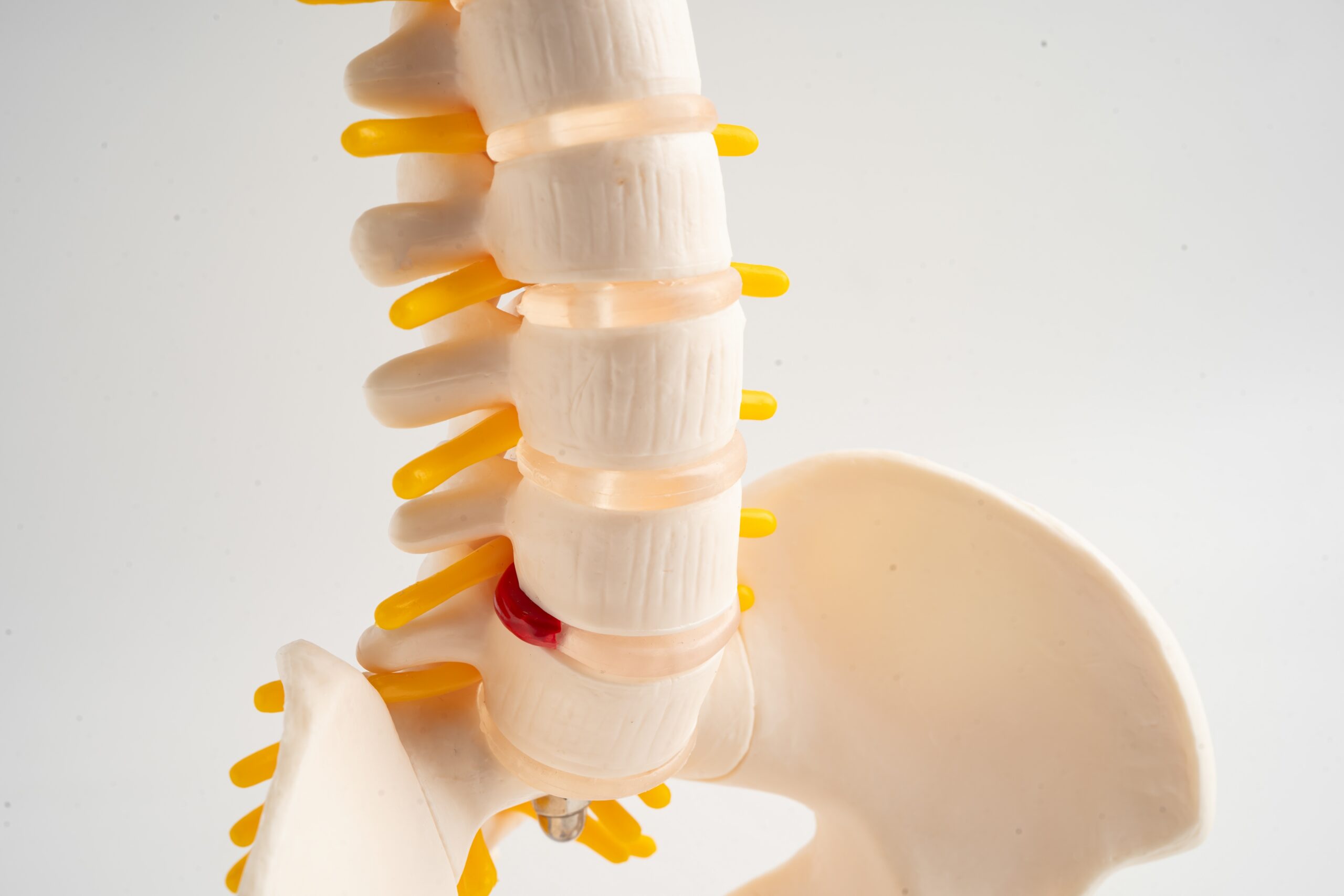
Let’s start with what a disc even is. Your spine is made up of bones stacked on top of each other, and between each of those bones sits a disc.
Think of the disc as a cushion — a shock absorber that sits between the bones, letting your spine move and bend and take load without the bones grinding together. Here’s a simple way to picture one: it’s a bit like a jam doughnut. A tougher ring on the outside, and a softer, jelly-like centre in the middle. Keep that image in your head, because it makes the rest of this easy to understand.
What Actually Happens with a Slipped Disc
So what’s a slipped disc? The proper term is a disc bulge, or a disc herniation.
Going back to the doughnut, what happens is the soft centre pushes out against the tougher outer ring. Sometimes it just bulges the wall outward. Sometimes the centre pushes far enough to poke through it. But the disc itself hasn’t slipped anywhere — it’s still exactly where it should be.
Now, why does that cause pain? It’s not usually the bulge itself that hurts. It’s where it bulges to. Right behind your discs run the nerves of your spine. So if the disc bulges backwards and presses on, or irritates, one of those nerves, that’s when you get the symptoms. And that’s why a disc problem often isn’t just back pain — it can send pain, pins and needles, or numbness down into the buttock and leg. That’s the nerve being irritated, and it’s what we call sciatica.
The Part That Will Reassure You
Now here’s the bit I really want you to hear. Disc bulges are incredibly common — and loads of people have them with no pain at all.
If you scanned a room full of people with completely pain-free backs, a big chunk of them would show a disc bulge on the scan. They’ve got one. They just don’t know it. It causes them nothing. So a slipped disc is not a life sentence. It’s not your back “going” or “crumbling.” It’s a common, normal finding — and very often it settles down on its own.
Do Slipped Discs Heal?
And that’s the next thing people always ask: will it heal? In most cases, yes.
The body is remarkably good at dealing with these. Over time, that bulge can shrink back and settle, and the nerve stops being irritated. Most disc problems get better with the right approach, time, and movement — without ever needing surgery.
So let’s pull it together. A slipped disc doesn’t slip. It’s a bulge — the soft centre of the disc pushing against the outer wall. It hurts when it irritates a nearby nerve, which can send symptoms down the leg. It’s incredibly common, often painless, and in most cases it settles and heals with time and the right approach. So if someone’s told you you’ve got a slipped disc, take a breath. It’s almost certainly not as bad as that name makes it sound — because it’s the name that scares people, and the truth shouldn’t.
Joe Sharp
BSc (Hons) Physiotherapy
Request A Free Discovery Call & Ask All The Questions You Need