


Five Causes — and the Three That Matter Most
Here’s something that will immediately make this more useful for you. There are actually lots of different causes of sciatica — but five of them make up the vast majority of cases, and within those five, three are responsible for most of what we see in clinic.
So rather than overwhelming you with every possibility, by the end of this article you’ll know those five causes, understand the three that matter most, and have a much clearer idea of which one might be driving your pain. Because here’s the thing about what causes sciatica: most people assume it’s a disc, and sometimes it is — but the sciatic nerve can be irritated or compressed in several completely different places, by several completely different things. And if you treat the wrong cause, you don’t just waste time, you can actually make it worse. So knowing what’s really driving it is the most important thing you can do. As always, this is a guide, not a diagnosis.
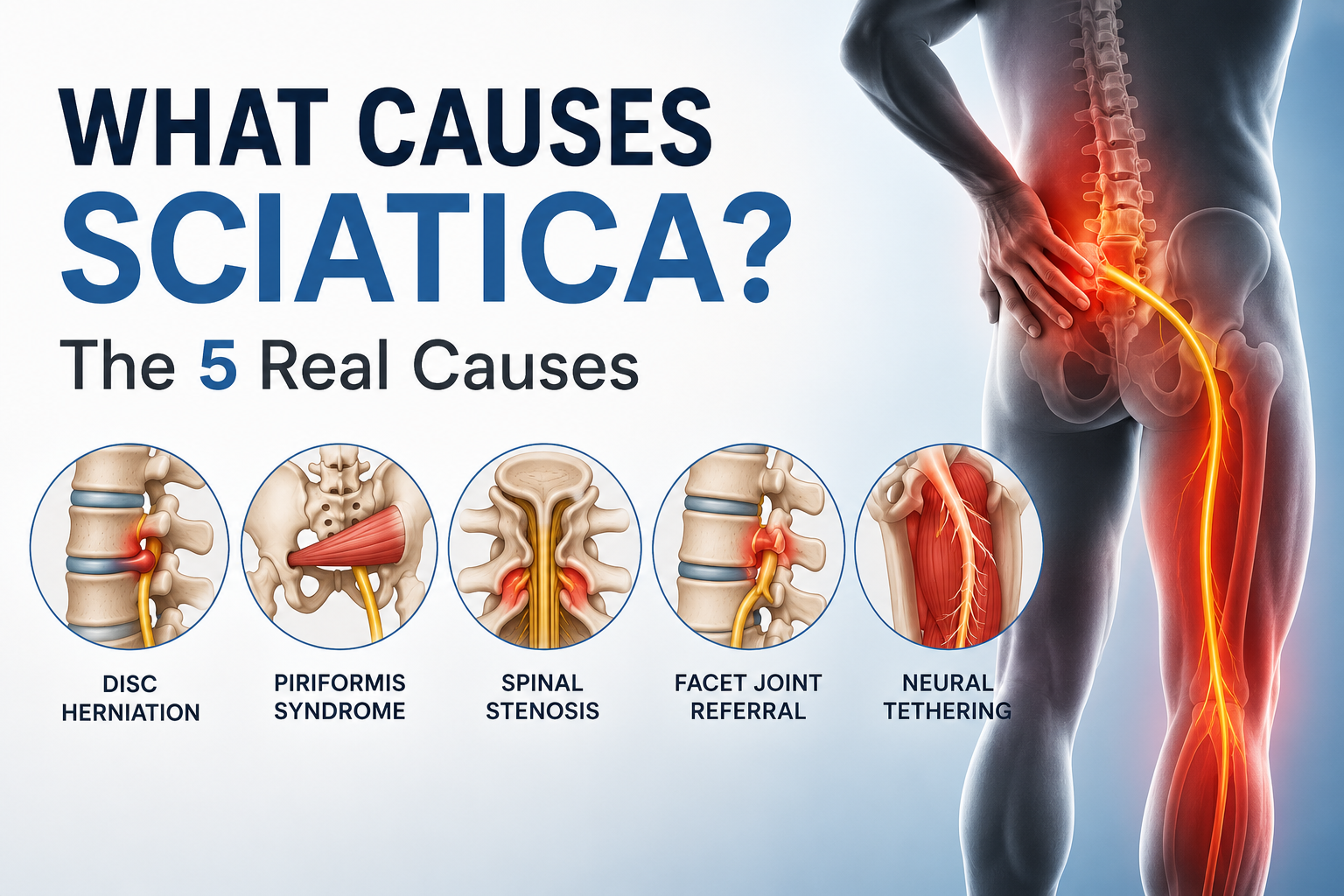
Cause 1 — Disc Herniation
This is the most common cause, and the one most people have heard of. Between each vertebra in your lower back sits a disc — think of it like a jam doughnut, a tough outer ring with a soft centre. When that outer ring weakens or cracks, the soft centre can bulge outwards and press directly onto the nerve root as it exits the spine.
But here’s what people don’t realise: the bulge itself often isn’t what causes the pain. It’s the inflammation that surrounds it. The disc material that leaks out is chemically irritating to the nerve, so even a small herniation can produce severe symptoms. That’s why reducing that inflammation is often the first priority — not surgery, not manipulation, but controlled movement, the right exercises, and time for that inflammatory response to settle. Disc sciatica tends to feel worse sitting, worse bending forward, and often comes with a specific line of pain that follows the nerve all the way down the leg, sometimes into the foot.
Cause 2 — Piriformis Syndrome
This one gets missed constantly, and it’s more common than most people think. The piriformis is a small, deep muscle that sits in your buttock, and the sciatic nerve runs directly underneath it — in around 15% of people, it actually runs straight through the muscle itself.
When the piriformis tightens — through prolonged sitting, overuse, or a direct knock — it can compress or tether the sciatic nerve and produce pain that feels identical to disc sciatica. Same burning, same shooting pain down the leg. So if you’ve been treated for a disc and it isn’t working, piriformis syndrome needs to be on the table. The giveaway is usually deep buttock pain that’s worse after sitting, worse going up stairs, and often reproduces when you press into the muscle itself. Treatment here is completely different — deep soft tissue work into the buttock, piriformis stretching, and hip strengthening.
Cause 3 — Spinal Stenosis
Stenosis means narrowing — in this case, narrowing of the spinal canal, the channel that the spinal cord and nerve roots travel through. As we age, the structures around the canal can thicken and encroach on that space. Bone spurs, thickened ligaments, degenerative changes — all of them can gradually squeeze the nerve.
Stenosis has a very specific pattern that helps identify it: the pain tends to get worse the longer you stand or walk, and better when you sit down or lean forward. Some people can only walk a hundred metres before the leg pain forces them to stop. So if your sciatica follows that pattern, stenosis needs to be investigated. It tends to respond to flexion-based exercises, postural changes, and in some cases more targeted intervention.
Cause 4 — Facet Joint Referral
The facet joints are the small joints at the back of each vertebra that give the spine its movement. When they become inflamed or arthritic, they can refer pain into the buttock and down the leg in a pattern that mimics sciatica.
But it’s not true sciatica — the sciatic nerve itself isn’t being compressed. It’s referred pain from the joint. And that matters, because treatment aimed at the nerve won’t touch it. The joint itself needs to be addressed — manual therapy, specific movement, and sometimes an injection if it’s severe.
Cause 5 — Neural Tethering
This one is less talked about but worth knowing. Sometimes the sciatic nerve gets tethered further down its pathway — in the hamstring, behind the knee, even into the calf — by scar tissue, tightness, or past injury. The nerve loses its ability to glide freely as you move, and that restriction creates pain.
It often feels less like a shooting pain and more like a deep, persistent ache that’s aggravated by movement. Neural mobilisation exercises — nerve flossing — are the primary treatment here, releasing the nerve’s ability to move freely through the tissue around it.
Why the Cause Matters More Than the Label
So there are your five causes: disc herniation, piriformis syndrome, spinal stenosis, facet joint referral, and neural tethering. Five different causes, all of them producing pain in the same general area, all of them needing a different approach.
And this is exactly why the diagnosis matters so much more than the label. Sciatica tells you which nerve is involved. The cause tells you how to fix it. So if you’re trying to understand what causes sciatica in your case, don’t stop at the word — work out which of these is actually driving it, because that’s the thing that decides what will genuinely help.
Joe Sharp
BSc (Hons) Physiotherapy
Request A Free Discovery Call & Ask All The Questions You Need