



The Real Question Isn’t Next Month — It’s the Next 20 Years
If you’ve torn your ACL and you’re tempted to just leave it, there’s one thing you really need to understand before you make that call — and that’s arthritis. Because the real question with an unfixed ACL isn’t how your knee feels next month. It’s what your knee looks like in ten or twenty years.
So in this article I’m going to walk you through what actually happens if you don’t fix a torn ACL — and why arthritic change is the part that matters most. I want to be balanced here: leaving a torn ACL isn’t automatically a disaster for everyone. But you do need to understand the long game before you decide.
It All Comes Down to Stability
The first thing to say is that it really comes down to one thing — is the knee stable, or does it keep giving way?
If you’re someone whose knee becomes stable through good strength and control — a “coper” — and it doesn’t give way on you, then living without an ACL can go perfectly well for years. Plenty of people do exactly that. But if your knee is unstable, and it keeps giving way when you turn, twist or catch it awkwardly, that’s a completely different story. And that’s the knee we worry about long term.
Because every one of those giving-way episodes isn’t harmless. It’s not just a wobble you walk off. Each time that knee shifts and buckles, it’s doing damage inside the joint — and that damage adds up. Hold onto that idea, because it’s the start of the chain that leads to arthritis.
The Chain of Damage
So let’s follow that chain. When an ACL-deficient knee gives way, the bones shift in a way they’re not designed to, and the structures that take the hit are the meniscus and the cartilage.
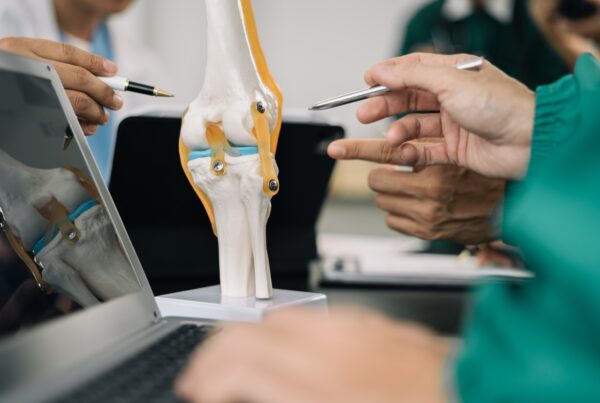
The meniscus is the cushioning in your knee — the shock absorber that sits between the bones. When the knee keeps giving way, you start tearing that meniscus, bit by bit, episode by episode. This is incredibly common in knees that have been unstable for a long time — what we call secondary damage. The ACL went first, and the meniscus follows.
Then there’s the cartilage — the smooth, glassy surface that caps the ends of the bones and lets the joint glide painlessly. Those same giving-way episodes, and the abnormal loading that comes with an unstable knee, start to wear and damage that cartilage surface too. So now you’ve got a knee that’s lost its stabiliser, is chewing up its shock absorber, and is grinding down its smooth surfaces. And that combination is exactly what sets the stage for arthritis.
Where Arthritis Comes In
This is the heart of it, so let me explain what arthritic change actually is. Arthritis — osteoarthritis — is when that smooth cartilage surface wears down and the joint starts to degenerate. The cushioning thins, the surfaces roughen, and eventually you get bone rubbing against bone. That brings pain, stiffness, swelling, and a knee that just doesn’t do what it used to.
And here’s the crucial part: once that arthritic change has set in, you can’t reverse it. You can manage it, but you can’t undo it. So everything we do is about protecting that joint and slowing the process down. When you leave an unstable ACL knee to keep giving way for years, you’re effectively speeding that process up. The repeated damage to the meniscus and cartilage is one of the biggest drivers of early arthritis we see — and losing meniscus tissue in particular is one of the strongest predictors of a knee going arthritic, because once that shock absorber is gone, the cartilage takes far more punishment. So the long-term cost of never fixing an unstable ACL often isn’t the ACL itself at all. It’s the arthritis that follows on behind it.
The Honest Bit — and What It Means for You
I want to be straight with you here, because this gets misunderstood. Having surgery does not make you arthritis-proof. The truth is that tearing your ACL raises your long-term arthritis risk no matter what you do, partly because of damage done at the moment of the injury itself. An ACL reconstruction is not a guarantee against arthritic change, and anyone who tells you otherwise isn’t being straight.
But — and this is the point — keeping the knee stable, whether that’s through surgery or through really good rehab, protects the meniscus and the cartilage from all that ongoing, repeated damage. And protecting those is how you give the joint its best chance of staying healthy for as long as possible. So “fixing it” was never really about the ligament for its own sake. It’s about stopping the slow, cumulative damage that drags a knee towards arthritis years down the line.
So where does that leave you? If your knee is stable and you’re coping well, the picture is reassuring — keep it strong, look after it, and stay on top of it. If your knee keeps giving way, take that seriously. That’s the knee most at risk of arthritic change, and it’s exactly the situation where doing nothing is the riskiest choice of all. The worst thing you can do is ignore a knee that keeps buckling and just hope it settles — that’s the path that quietly does the damage. Get it properly assessed, and make an informed decision while you still have all your options open.
Joe Sharp
BSc (Hons) Physiotherapy
Request A Free Discovery Call & Ask All The Questions You Need